

Views: 0 Author: Site Editor Publish Time: 2026-10-07 Origin: Site


Power outages on a construction, mining, or commercial site translate directly into severe operational downtime. Damaged industrial equipment and significant lost revenue usually follow. Securing a reliable independent power source is a fundamental engineering requirement when establishing temporary or permanent site infrastructure.
However, project managers frequently miscalculate the required capacity. Choosing the wrong size leads to major mechanical and financial issues. Under-sizing causes system overloads, transient voltage dips, and subsequent equipment failure. Conversely, over-sizing wastes diesel fuel. It also induces wet stacking, a condition where an engine operating under a light load fails to reach optimal temperatures. This leads to carbon buildup and unburnt fuel in the exhaust system.
This technical guide helps you determine the exact specifications required for your site. We will detail load calculations, safety margins, and standard industrial form factors. Whether you are powering a single temporary site office or require a heavy-duty centralized power plant for a remote mining operation, you will find the exact engineering standards below.
Calculate in kVA, not kW: The most frequent sizing mistake in the industry is failing to divide total kilowatts by the standard power factor of 0.8 to find the required kilovolt-amperes.
The 30 Percent Safety Rule: Industrial diesel engines should not operate continuously at maximum capacity. Adding a safety margin accommodates motor starting currents and prevents premature wear.
Site Office Quick Sizing: A standard 20-foot site office typically requires a 10 kVA unit. A fully equipped 40-foot office requires between 12.5 kVA and 15 kVA.
Industrial Scale Power: For heavy-duty site-wide power distribution, a 20-foot footprint usually covers loads up to 1250 kVA. A 40-foot enclosure is engineered for multi-megawatt requirements.
Estimating power requirements through guesswork is a high-risk approach for industrial operations. The electrical demands of a commercial site fluctuate constantly. These fluctuations depend on operational phases, environmental conditions, and concurrent equipment usage.
Undersized power units struggle with sudden demands from heavy machinery. This causes severe voltage and frequency drops. Imagine a tower crane stalling mid-lift or a massive industrial pump failing to engage. These power surges and sags can instantly fry sensitive electronics located inside site offices. Furthermore, if the system cannot supply the necessary starting current, critical electric motors will simply fail to start. This brings site operations to a grinding halt.
In contrast, diesel engines are mechanically engineered to run most efficiently at 70 to 80 percent of their rated load. Operating consistently below a 30 percent load causes the cylinders to glaze. Unburnt fuel will eventually leak from the exhaust. By accurately calculating the required capacity, you ensure the engine operates within its optimal thermal window. Consequently, this maximizes fuel efficiency, extends maintenance intervals, and preserves your equipment lifespan.
Recent market analysis reveals a massive shift in how site engineers approach temporary and permanent power generation. Environmental regulations are tightening globally. Urban noise ordinances dictate stricter compliance. Because of these factors, the industry is rapidly moving away from exposed skid-mounted units.
Specifically, there is a massive surge in demand for fully enclosed systems offering advanced acoustic dampening and emission controls. Modern project sites demand scalability. Operators are increasingly deploying modular setups rather than investing in a single monolithic power plant that runs inefficiently during low-demand periods. By synchronizing multiple enclosed units, site engineers adapt dynamically to fluctuating electrical loads. This data-driven approach minimizes fuel consumption and significantly reduces the carbon footprint of heavy industrial operations.
Electrical engineers utilize a standardized operating procedure to calculate site loads. Follow these crucial steps to determine the exact power capacity required for your specific application without relying on guesswork.
The first step is to audit and list every piece of electrical equipment running simultaneously during peak operational hours. You must calculate the total running wattage measured in kilowatts. You can typically locate this information on the data plate attached to the machinery.
Once the base load is established, you must factor in transient loads. Devices equipped with electric motors draw massive amounts of power upon startup. Additionally, welding rigs firing up simultaneously will cause sudden electrical spikes. Industry standards dictate adding a 30 percent safety margin to your base load to protect the system.
This next step is where most sizing errors occur. Equipment power consumption is measured in real power kilowatts. However, industrial power systems are rated in apparent power kilovolt-amperes. To convert your load, you must divide your total kilowatts by the power factor. For standard commercial and three-phase industrial sites, the accepted power factor is 0.8.
Finally, always round up to the next standard size. Generators are manufactured in standard capacity tiers. Squeezing your calculated load onto a perfectly matched unit leaves zero margin for error. Selecting the next commercially available size is the safest engineering decision.
Detailed calculations may not always be feasible prior to rapid equipment deployment. Based on historical data across standard construction and mining camps, we compiled a standardized comparison to guide your procurement process.
| Enclosure Type | Power Range | Ideal Application | Key Engineering Features |
|---|---|---|---|
| Standard 20ft Site Office | 10 kVA - 15 kVA | Basic lighting, IT setup, small HVAC | Compact footprint, single-phase options |
| High-Load 40ft Hub | 20 kVA - 30 kVA | Multiple HVAC units, server racks, tool charging | Enhanced surge capacity, three-phase power |
| 20GP ISO Container | 500 kVA - 1250 kVA | Medium construction sites, commercial backup | CSC certified, integrated daily fuel tank |
| 40GP ISO Container | 1250 kVA - 2500+ kVA | Remote mining camps, data centers, grid support | Multi-megawatt V-block engines, oversized radiators |
Small skid-mounted units are sufficient for individual offices. However, powering an entire industrial site requires heavy-duty centralized power plants. This is where ISO standard enclosures become essential for operational security.
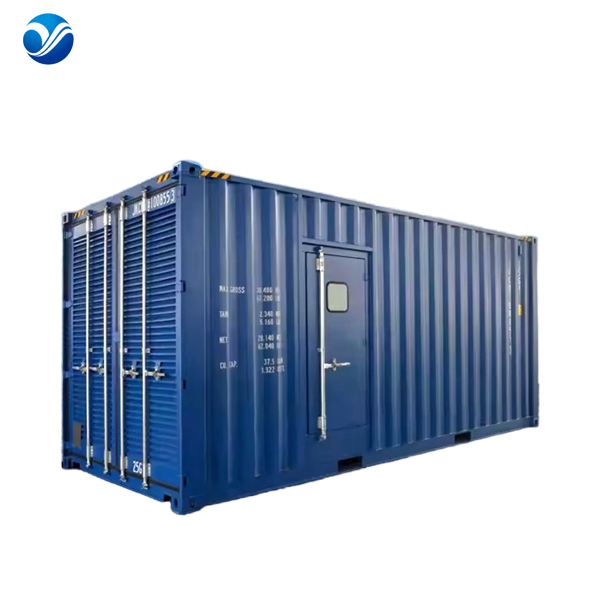
A 20gp container generator utilizes a standard 20-foot shipping container as its structural enclosure. This design seamlessly integrates the diesel engine, alternator, cooling system, and fuel tank into a highly durable shell. These units typically house generating sets ranging from 500 kVA up to 1250 kVA. They are ideal for medium-to-large construction sites where spatial footprint is limited but high power output is strictly required.
For operations with massive electrical demands, the 40gp generator is the undisputed industry standard. Built into a 40-foot enclosure, these units provide the physical space necessary for larger V-block engines and advanced exhaust systems. They are strictly engineered for heavy industrial applications and large-scale infrastructure projects. The extra internal space also accommodates massive double-walled fuel tanks for extended uninterrupted runtimes.
When evaluating power solutions for harsh environments, buyers must choose between exposed models and fully enclosed units. Investing in a high-quality containerized genset offers distinct operational advantages that directly impact site safety.
Urban construction sites face strict municipal noise pollution regulations. Open-type engines produce deafening noise levels that violate occupational health standards. A properly engineered soundproof container significantly mitigates acoustic emissions. By utilizing heavy-duty acoustic paneling and specialized residential-grade exhaust silencers, these units can reduce operational noise down to a highly manageable 65 to 75 decibels at a distance of 7 meters.
Remote sites also expose equipment to highly corrosive environments, abrasive dust, and extreme temperature fluctuations. The rugged corrugated corten steel exterior of an ISO container provides an impenetrable barrier. High IP-rated louvers prevent water and dust ingress while maintaining necessary airflow for engine cooling. Furthermore, heavy-duty locking mechanisms on all access doors prevent unauthorized personnel from tampering with control panels and eliminate diesel fuel theft.
Even seasoned project managers can make miscalculations when procuring site power. To ensure continuous operation and protect your capital investment, avoid these common engineering pitfalls.
Forgetting that electric motors draw massive starting currents is the leading cause of system failure on site. Always account for the locked rotor amps of your heaviest machinery. Additionally, maxing out your capacity leaves no room for error. Running at maximum load causes the engine to overheat, degrades the alternator insulation, and drastically shortens the equipment lifespan.
Finally, never overlook altitude and temperature derating. Diesel engines rely on oxygen to burn fuel. At high altitudes, the air is thinner. In extreme heat, the air is less dense. In both scenarios, the engine produces less power. If your site is located high in the mountains or in a desert environment, you will need to select a larger size to compensate for this natural loss of power.
Selecting the right power equipment is a critical decision. Look for manufacturers that offer robust engineering support alongside their physical products. A reputable manufacturer will offer deep customizability to meet your specific site demands. This includes integrating larger fuel tanks, specifying particular alternator brands, or installing smart control panels for remote monitoring. Partnering with a manufacturer that understands kVA calculations, environmental derating, and acoustic engineering is essential for your project success.
Getting your site power sizing right is a precise engineering task. It requires an accurate calculation of your base load, the application of a strict safety margin, and the correct conversion to apparent power. Once your power requirements are defined, choosing the right form factor ensures your entire site load is managed efficiently and securely.
Stop guessing your power requirements and risking your operational uptime. Need help calculating the exact electrical demands for your project? Visit CYEC Generator at https://www.cyecgenerator.com to browse our premium range of containerized power solutions. Contact our engineering team today for a custom sizing consultation and technical assessment.
For a standard 40ft site office running air conditioning, multiple computers, printers, and lighting, a 12.5 kVA to 15 kVA unit is highly recommended. This capacity safely handles the continuous load and air conditioning starting surges.
Kilowatts represent the actual real power your electrical equipment consumes to perform work. Kilovolt-amperes measure the total apparent power the system must produce. You convert your total kilowatts to kilovolt-amperes by dividing it by the system power factor, which is generally 0.8 for industrial sites.
A 20GP containerized unit is typically used for heavy industrial loads. Depending on the internal engine block and alternator configuration chosen, it easily produces anywhere from 500 kVA up to 1250 kVA.
Yes, high-quality containerized units are highly weather-resistant and engineered to severely dampen noise. They utilize acoustic rock wool paneling and specialized exhaust silencers to drastically reduce decibel output. This makes them perfect for harsh weather environments and noise-regulated urban areas.
Absolutely. Modern containerized units equipped with advanced smart controllers can be easily synchronized. Running multiple units in parallel allows site managers to scale power up or down based on real-time site demands, significantly improving fuel efficiency and providing built-in redundancy.
High altitudes feature lower air density, meaning less oxygen is available for the combustion process. This causes the diesel engine to lose horsepower, a process known as derating. Engineers typically upsize the generator capacity by roughly 3 percent for every 1,000 feet above sea level to compensate for this power loss.


